
Improve Your Golf Game With Artificial Grass
Need to improve your short golf game? Nothing beats practice time with a club in your hands. However, it’s not always easy to find the time to make it to the golf course. Wouldn’t it be great if you could have a putting green at your home? How about a pitching practice green?
It’s entirely possible to have your very own artificial grass golf pitching and putting green right in your very own yard.
Take a break during your day for a quick 15-minute practice session! Introduce the kids to the game of golf!
Read on to understand what to look for in artificial grass for golfers, and also how to install an artificial grass pitching and putting green.
Why Artificial Grass for your Pitching and Putting Green?
Are you a qualified and experienced landscape gardener, with a solid background in lawn care? Do you LOVE mowing and weeding? No?
A high-quality natural grass pitching and putting green would take a skilled and experienced installer many months and much care and attention to grow from seed. Even if you installed ready-grown turf, it would need regular ongoing maintenance. Lastly, if you used it a lot you are likely to flatten and wear it out, especially if you don’t have much space.
With artificial grass you can install your pitching and putting green in a day. Better still, it will never need mowing and is easy to replace if it gets worn.
One thing we should clarify… in this article we’ll be talking about artificial grass pitching and putting green, and not driving ranges. While artificial grass can be used for driving ranges, it can be quite hard on your clubs. Natural grass will give up a divot if your swing is low, while artificial grass is not so forgiving and may damage the club head. Pitching swings are lower in power, so even if you do swing low you shouldn’t damage your club.
Space Considerations
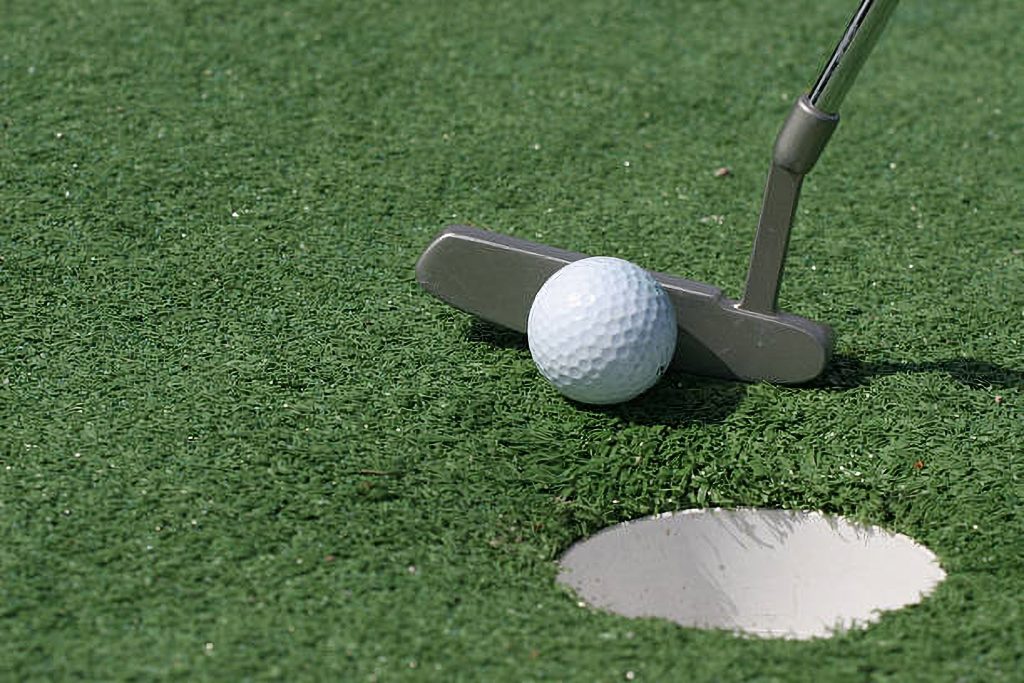
The first step is to work out how much space you can allocate to your artificial grass pitching and putting green. Graph paper and a measuring tape are invaluable tools for this task. There are many considerations here, notably the views of any non-golfers who also use the space (you know who we mean!), and also your golfing skill level.
Why is golfing skill a consideration? Well, a beginner golfer would get a lot of value out of a relatively simple and small putting green. An experienced golfer would need something larger and more complicated to provide an interesting challenge.
Artificial grass pitching greens require a lot more space than a putting green. This is partly because the ball is hit further, but mostly because you need more space around the target area in case the ball goes off course. On the flip side, an artificial grass pitching green doesn’t need a continuous length of artificial grass between where it is struck and hole, as the ball travels most of the way in the air.
To give you an idea of what kind of size to consider, putting greens used in PGA Tours are around 5,000 to 6,000 square feet, while a normal non-PGA green is around 1,000 to 1,500 square feet. A typical size for a backyard putting green is about 500 square feet. This is roughly equivalent to a 10-foot by 50 feet strip, or a circle with a diameter of 25 feet.
If you don’t have this kind of space, then you may need to downsize your putting green, and get creative to fit in a pitching green! For the pitching green, remember you don’t need a continuous length of artificial grass: just at the start and the target. For the putting green, there are many smaller versions available at a modest cost.
What Type of Artificial Grass Should I Buy for a Putting Green?
You shouldn’t just go out and buy any old artificial grass for your putting green. As a golfer, you will have noticed that the grass on the putting green is much, much shorter than the grass on the fairway. The same applies to artificial grass putting greens. You will need a pile height (the length of the grass blades) of around half an inch. Anything longer and the ball will not roll naturally over the artificial grass.
The pile height for the average lawn is much longer, at around 1 to 1.5 inches. So unfortunately an artificial grass putting green won’t look completely natural in your yard.
The other factor to consider is the material that the artificial grass is made of. The blades in artificial grass are called yarn. The yarn can be made out of a number of different materials, typically one of:
- Polyethylene (PE),
- Polypropylene (PP), and
- Nylon.
Polypropylene has the softest feel of the three materials. However, it is also the most prone to wear. For artificial grass putting greens, nylon is a good choice as it is very hard-wearing.
If you’d like to know more about the different types of artificial grass, then check out our artificial grass buying guide.
What Type of Artificial Grass Should I Buy for a Pitching Green?
As with the pile height for putting greens, when considering pile height for pitching greens, try to mimic the natural world. A longer pile height of around 1 to 1.5 inches best mimics the longer grass around greens.
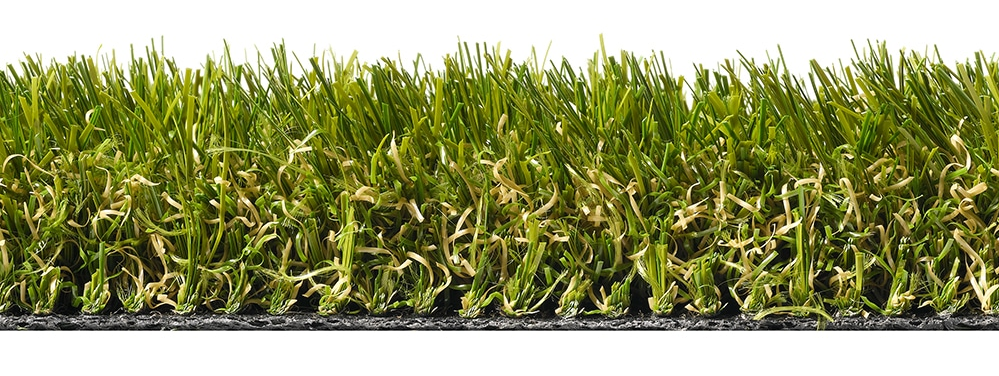
If you look closely at natural grass, you will see that in between the long green blades are short and curly brown blades. Natural grass blades are constantly dying and renewing, and this layer of dead blades is called thatch. A thicker thatch will make the artificial grass feel more springy underfoot. The best artificial grass for a pitching green will have a thicker thatch. This is because if you swing low and strike the artificial grass, it won’t give way like natural grass and dirt. While a pitch is not a high-energy swing, choose an artificial grass with a thicker thatch to help protect your clubs.
As with putting greens, the best artificial grass material to use for a pitching green is nylon.
What Other Factors Should I Consider?
Artificial grass comes in many different shades of green. If you are laying an artificial grass pitching or putting green next to natural grass, you may choose a color that matches the natural grass. More realistic artificial grasses have four or more different tones in their makeup.
The ability of artificial grass to allow water to pass through is largely dependent on the backing material. While good drainage is a feature of most artificial grasses, the backing material of dedicated putting green products is very smooth and does not drain well. Make sure to bear this in mind when you are installing your artificial grass putting green.
For help with installation, check out our series of artificial grass installation guides.
Conclusion
There are a few things that you need to bear in mind when choosing artificial grass for your putting or pitching green. You will need a shorter pile height and nylon yarn for the putting green, and a longer pile height and thicker thatch for the pitching green. Aim to match the artificial grass color as close as possible to natural grass, and make sure to check the drainage capabilities of the backing material. With these points in mind, you can be sure to get the right artificial grass for your golfing needs.